

An outdated system, shared access, a repeated password… Pentesting identifies these vulnerabilities before an attacker can exploit them. It’s not about attacking for the sake of attacking, but about thinking like someone who wants to get in… to prevent it.
What is pentesting?
Pentesting, also known as a penetration test, involves simulating a real-world attack against a software or hardware system to identify vulnerabilities before malicious actors can exploit them. In other words, it’s about testing your computer systems, networks, or applications. The same techniques that an attacker might use are employed to validate security in a real-world scenario.
In this context, the terms “ethical hacking” and “penetration testing” are sometimes used interchangeably, but there is a difference. IBM (International Business Machines) explains that ethical hacking is a broader field of cybersecurity that includes any use of hacking skills to improve network security. Meanwhile, penetration testing is just one of the methods ethical hackers use.
Types of tests based on the attacker’s knowledge.
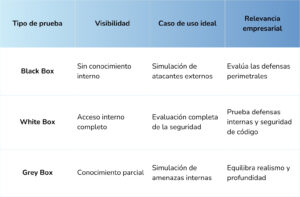
Pentesting is not always done the same way. Depending on the information and access provided, the test can simulate an external attack or focus on finding specific vulnerabilities. Therefore, the approach will depend on how much information the pentesters have beforehand. This classification is based on three approaches, commonly referred to as “Black Box”, “White Box”, and “Gray Box” testing.
- In a Black Box test, pentesters have no information about the target system. The only thing they know is the organization’s name or a public URL. They must conduct their own reconnaissance to develop an attack plan, just as a real-world hacker would. It is especially used in web pentesting or external tests.
- In a White Box test, analysts have full transparency into the target system. The company shares details such as network diagrams, source code, credentials, and much more. It is also known as “Crystal Box” or “Clear Box.”
- In a Gray Box test, pentesters obtain some information, but not much. For example, the company may share IP ranges for network devices, but analysts have to probe those IP ranges for vulnerabilities on their own. It is generally considered the most common approach and balances the efficiency of the White Box with the realism of the Black Box: It makes it possible to assess the potential damage that could be caused by a user with legitimate access and validates internal security and network segmentation, as explained by WAU Technologies.
The phases of pentesting.
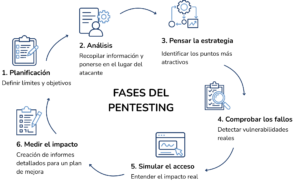
Pentesting is not a one-time or improvised action. It is a structured process that reproduces, step by step, how someone attempting to gain unauthorized access to a system would operate. These are the key phases:
1. Laying the groundwork (defining scope and objectives)
Before starting, the rules of engagement are established:
This involves defining which systems will be assessed, identifying domain names and IP addresses, establishing the limits of the test, and determining how to respond to any incidents. This phase ensures that the test is secure, legal, and aligned with business objectives.
It’s not about “testing for the sake of testing,” but about knowing exactly what needs to be protected.
2. Seeing things from an external perspective (analysis, information gathering)
This is where the process of putting ourselves in the attacker’s shoes begins; our goal is to gain a panoramic view.
The pentester analyzes what information is publicly available, what systems are exposed, and what clues could facilitate unauthorized entry. The more information someone finds from the outside, the easier it is for them to get in.
3. Developing the strategy (identifying the most attractive points)
Based on this information, potential attack paths are prioritized. As WAU Technologies explains, in this phase, high-value assets are identified, and scenarios are established to plan how access to the system will be attempted.
Not everything is attacked: the vulnerabilities that could have the greatest impact if exploited are prioritized.
Just as a thief wouldn’t try every door, but would look for the weakest one.
4. Checking for flaws (detecting real vulnerabilities)
In this phase, systems are analyzed to identify errors, insecure configurations, or risky habits. Tools are used to massively scan identified assets, and the pentester performs manual tests to detect vulnerabilities that machines overlook.
Not only “technical” flaws are sought, but also issues related to usability, design, or business logic.
Here, real risks are separated from those that only appear to be so.
5. Testing what could happen if an attacker gains access
At this point, an attempt is made to check how far an attacker could go by exploiting these flaws. The pentester attempts to exploit confirmed vulnerabilities.
The goal is not to cause damage, but to understand the real impact of an intrusion: remote exploitation, web application attacks, password attacks, and/or social engineering.
Because “they could get in” is not the same as “this is what would happen if they get in.”
6. Measuring impact and learning from the results (reporting and remediation)
The final phase translates the findings into actionable insights: what was detected, what risks exist, and how to solve them. This stage is crucial for the organization to recognize risks and implement corrective actions. Detailed reports provide a clear roadmap for improving security.
The true value of pentesting is not in finding flaws, but in knowing how to fix them. And this is the key differentiator between a vulnerability scan and a professional pentest.
Thanks to these tests, you can strengthen your defenses, prioritize investments, and check if your teams and processes are prepared to respond to a real threat (WAU Technologies).
In summary.
Pentesting is an exercise in anticipation.
It is a process that allows organizations to put themselves in the shoes of someone attempting to gain unauthorized access, so they can strengthen their defenses before it’s too late. Because the best way to protect a system is to understand how an attacker might compromise it.