
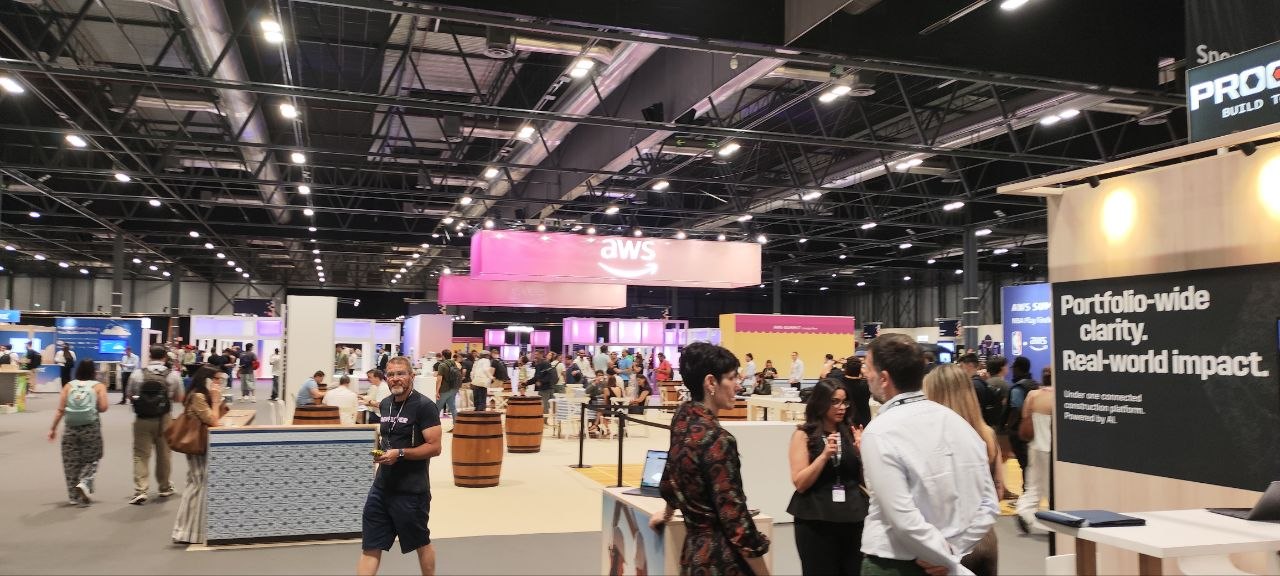
More than 140 sessions, thousands of attendees, and a conclusion shared across nearly all talks: AI has moved from promising to becoming the core of next-generation architectures. From the evolution of data lakes into agent-based ecosystems to the renewed focus on fundamental concepts such as proper requirements definition, the AWS Summit Madrid 2026 provided a clear snapshot of where the industry is heading.
Much more than an event for AWS users.
Before delving into the main technological innovations presented during AWS Summit Madrid 2026, it’s worth pausing to consider an aspect that often goes unnoticed: the value these events provide to a wide range of profiles within the technology sector.
For those in the learning or upskilling stage, the Summit offers access to practical labs, training sessions, and resources aimed at both acquiring knowledge and preparing for official AWS certifications.

For business leaders, operations managers, or solution architects, it represents a particularly interesting opportunity to network, compare experiences, and understand where the market is heading, what priorities organizations are setting, and what strategies clients, partners, and competitors are following.
More technical profiles also find a very useful environment to discover technologies outside their usual area of specialization, validate architectural approaches, or learn how other companies are solving similar challenges.
From the perspective of participating companies, especially those with their own stand or presenting as speakers, the Summit becomes a privileged showcase to gain visibility, strengthen positioning, and generate new business opportunities. Although, as with any major technology event, this exposure also involves displaying some of their capabilities, methodologies, and success stories to an audience that includes not only potential clients but also competitors observing closely.
The event’s biggest challenge: choosing what to miss.
If one had to point out a less positive aspect of AWS Summit Madrid 2026, it would probably be the difficulty of making the most of all the available content in a single day.
The event packs more than 140 sessions, practical workshops, certification preparation areas, product demonstrations, networking activities, and commercial exhibition areas into just seven effective hours. To this, one must add moving between sessions, conversations with other attendees, and the inevitable breaks for coffee, lunch, or meals.
Paradoxically, the enormous amount of available content ultimately becomes one of the main challenges for attendees. It is impossible to attend everything that might be of interest.
Furthermore, there is a noticeable difference between the various presentation formats. The large sessions held in the main auditoriums usually feature more experienced speakers, more developed use cases, and a significantly higher level of technical or strategic depth. In contrast, some of the shorter talks or quick talks adopt a more commercial or introductory approach.

Adding to this difficulty is a suboptimal planning experience. The application used to navigate the agenda does not particularly facilitate the identification of the most relevant sessions for each professional profile. As a result, it is relatively common to end up attending talks that add little value while missing out on others that are potentially more interesting.
Even when one manages to access a high-level session, the proximity of other attractive presentations creates a constant feeling of missing out on relevant content. It is true that a large part of the sessions are later available for on-demand viewing. However, the reality is that few people have the necessary time to review them with the same attention once the event has concluded.
The in-person experience remains the moment where most learning is concentrated, and precisely for this reason, better curation and organization of content would have a very positive impact on the overall value of the Summit.
Artificial intelligence, the clear protagonist.
If one had to summarize AWS Summit Madrid 2026 with a single theme, the answer would be clear: artificial intelligence.
Practically all presentations, regardless of their original scope, ended up connecting in one way or another with generative AI, agent-based systems, and the new governance and security practices necessary to operate these types of solutions in enterprise environments.
The vision presented during the event was clearly influenced by the current state of the technology market. At times it even seemed excessively optimistic, with a tendency to present agents as the answer to very diverse problems.
However, beyond the inevitable commercial component, the underlying message is difficult to ignore.
The technology industry is directing a significant portion of its investments, efforts, and innovation processes towards this new paradigm. The conversation no longer revolves around whether AI will impact organizations. The question is how to integrate it effectively, securely, and scalably within existing processes and platforms.
From data to agent: an evolution that has already begun.
One of the most interesting examples presented during the event was the use case shared by Mapfre.
The session showed how architectures traditionally associated with Big Data and Data Lakes are evolving to integrate into ecosystems based on intelligent agents. The idea is especially relevant because it breaks with a simplistic view that still exists in many organizations. It’s not just about building conversational interfaces on top of existing data.
The trend points to systems capable of discovering information, making decisions, executing actions, and collaborating with each other using the data assets already present in the company. In other words, data is no longer just a source of insight but becomes an active component within automated processes capable of generating value autonomously.
It is a natural evolution of the data platforms that many companies have been building for years and that now find a new layer of exploitation thanks to artificial intelligence.
The most important lesson is not new.
Curiously, one of the most interesting reflections from the event is not new at all. The growing importance of so-called prompt engineers and the careful design of instructions for generative models is once again bringing to the forefront something that software engineering has been demonstrating for decades.
The correct definition of the problem remains one of the most decisive factors for the success of any technology project. For years, we have seen projects fail because requirements were poorly defined, because real business needs were not correctly understood, or because the developed solution did not address the problem it was intended to solve.
Artificial intelligence does not change this reality. It simply makes the cost of making those mistakes more visible.

The difference is that where before mainly analysis and development hours were consumed, now tokens, computing capacity, and inference resources are also consumed. Technology evolves. The importance of correctly understanding the use case remains exactly the same.
Conclusions.
AWS Summit Madrid 2026 confirms something that has been observed in recent months: artificial intelligence has ceased to be an isolated technology to become a cross-cutting layer that is transforming practically all disciplines of the technology sector.
Cloud, data, software development, operations, automation, and advanced analytics are now moving in a common direction.

For those working within the AWS ecosystem, attending the Summit remains an extraordinary opportunity to stay updated and learn firsthand about the trends that will shape the coming years. But even for professionals operating with other technologies, the value of the event is evident.
Because beyond the specific tools, what is truly important are the signals that anticipate where the industry is heading. And if one thing became clear during this edition, it is that the immediate future will be marked by three concepts: artificial intelligence, agent-based architectures, and data governance.
Probably no one manages to get the most out of the Summit. The amount of content, activities, and interesting conversations far exceeds the time available during a single day. Perhaps that is precisely one of the best signs of the event’s health.
You always leave with the feeling of having missed things. And also with new ideas, contacts, and perspectives that make it well worth attending.