
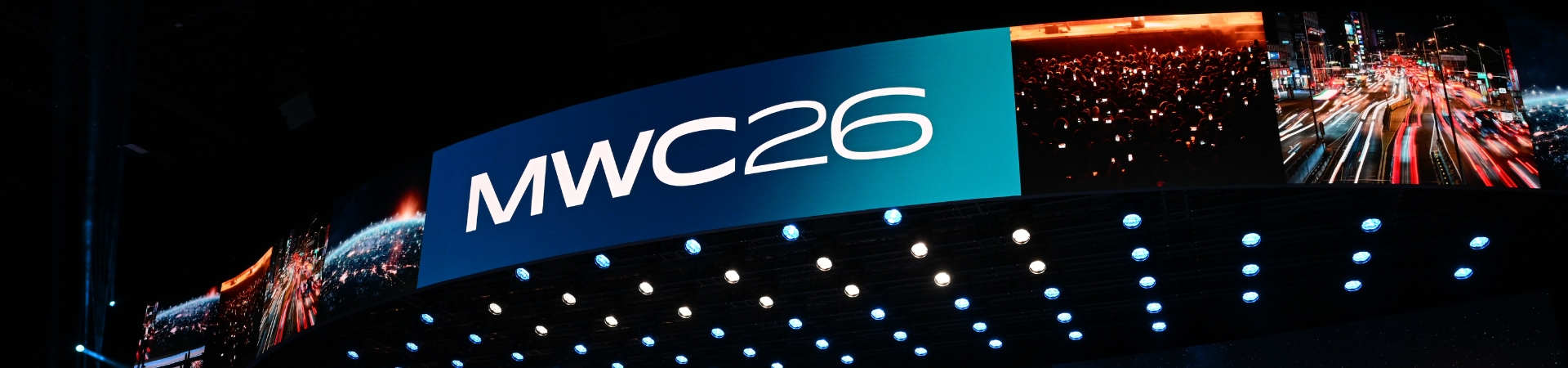
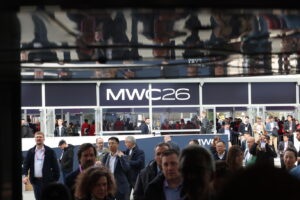
The Mobile World Congress (MWC) 2026 was not just another edition full of empty promises. With over 105,000 attendees from 207 countries at the Gran Via venue of Fira de Barcelona, the event exceeded the organization’s expectations, as explained by John Hoffman, CEO of the GSMA. In a complex geopolitical context, marked by tensions in the Middle East that impacted the event’s logistics, the industry responded with a clear message: stability and sovereignty.
The event brought together 2,900 exhibitors, sponsors, and partners, along with over 1,700 speakers and thought leaders, 40% of whom were C-level speakers, and 35% were women.
This year also marked two decades of the event’s presence in Barcelona. This edition highlighted how AI is permeating all sectors—yes, we are talking about Artificial Intelligence.
AI leaves the cloud: the shift towards the hybrid model.
One of the major debates of this edition has been whether the current AI model is sustainable. Faced with the saturation of services based exclusively on the cloud, the “On-Device” (Edge Computing) trend has taken the lead.
From our company’s IoT technical management, the assessment is clear: the future is not black or white: “The market needs to move to a hybrid model. Relying exclusively on the cloud for these systems is a cost and efficiency problem. What truly makes sense is a mixed model where device resources are used, and only if necessary, the cloud is accessed”. This approach not only optimizes resources but also strengthens data security, one of the priorities for Spanish companies at this congress.
Robots or Smartphones? The dilemma of “Embodied AI”.
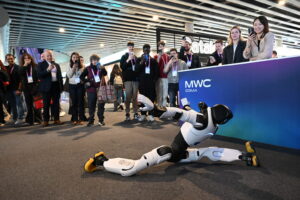
The event showcased the rise of ‘Embodied AI’, a trend where logical intelligence merges with physical actuators and motion sensors. Although brands like Honor or ZTE have led these prototypes, the sector maintains technical caution.
Our colleague warns about the risk that these innovations remain purely cosmetic: “It’s normal for these add-ons to be attempted to combine AI with devices, but whether it’s a gimmick or not remains to be seen. A robotic arm attached to a screen seems to me, from the outset, an added problem to the device rather than a solution”. History proves him right: technologies like foldable screens, which have been around for years, are still struggling to become the mass market standard.
Ubiquitous Connectivity: The Challenge of Satellite and IoT.
Satellite connectivity Direct-to-Cell (NTN) has been another pillar. While it aims to reduce dead zones globally, its application in the Internet of Things (IoT) still faces economic barriers.
This will greatly reduce areas without coverage, but reaching zero is almost impossible, notes our expert. In the IoT realm, this is still in its early stages; the associated cost is high for massive implementation, although it’s a matter of time until new protocols bring costs down.
Towards Smaller and More Sovereign Technology.
One idea stood out across the halls of Fira de Barcelona: the need for more ethical and efficient AI. In this regard, Spanish companies like Multiverse Computing are gaining traction by focusing on compact and low-consumption AI models.
The key is to make AI safer and more efficient; the current model won’t work”, concludes our specialist. “We need smaller, cheaper AIs with lower resource costs.
MWC 2026 leaves us with a lesson in maturity. It’s no longer enough for a device to be smart; now it must be sovereign, efficient, and, above all, useful in the physical reality of a world that increasingly demands tangible solutions.