

The Internet of Things (IoT) is not a fad, nor just another technical term. It is the logical evolution of digitalization: connecting physical objects to the digital world so they can capture data, communicate with each other, and enable real-time decision-making.
IoT explicado (por fin) con claridad: qué es, para qué sirve y por qué ya lo usas cada día
It is a tangible reality that is transforming processes, business models, and results. In July 2024, the IoT Analytics report updated the ranking of the 10 most implemented IoT use cases globally, and the data is clear: almost 92% of companies have already achieved a positive ROI from their IoT projects, and adoption has grown by 53% since 2021.
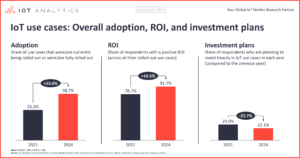
According to the “IoT Use Case Adoption Report 2024,” published by IoT Analytics in July 2024, 27 different use cases were analyzed based on a survey of 200 end-users of IoT solutions. The 418-page study offers a detailed view of the market status and how companies are implementing these technologies with measurable results.
The complexity of IoT projects has significantly decreased in recent years. While in 2021 many professionals highlighted the need for proofs of concept and pilot projects due to the technical and operational complexity of deployments, in 2024 this perception has changed. According to the report, challenges associated with ease of use and the configuration/integration of use cases have dropped to fifth and sixth place in the ranking of challenges. This simplification is a key catalyst for IoT adoption.”
However, IoT spending growth in 2024 shows signs of moderation. Although 51% of surveyed organizations plan to increase their investment in use cases this year compared to 2023, they will do so at a more contained pace. In 2023, the average growth was 8.4%; in 2024, the average forecast for budget increase is around 2%. This trend points to a consolidation phase, where many companies are optimizing investments and prioritizing use cases with proven returns.
From process automation to connected product traceability, IoT is redefining the boundaries of efficiency and control. This article covers the cases with the highest adoption and return on investment, with concrete examples, impact metrics, and key trends by sector.
The Current Map of IoT Business Value
1. PROCESS AUTOMATION
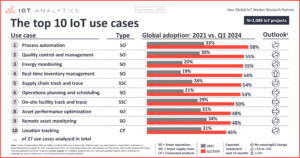
- Adoption: 57.5% of organizations (compared to 33% in 2021).
- Impact/KPI: The main KPI affected is labor efficiency. On average, a significant deployment of this use case improves labor efficiency by 8.2%.
- Key aspects: Sensor integration, edge computing, and connectivity.
- Example: Burnley Brewing automated part of its production, reducing the need for direct labor and improving traceability. IoT sensors, PLCs, and other action-enabling hardware were placed throughout the beer manufacturing process for subsequent data collection and process action.
2. QUALITY CONTROL AND MANAGEMENT
- Adoption: 55% (compared to 30% in 2021).
- Impact/KPI: The main KPI affected by quality control and management is, not surprisingly, product quality. On average, a significant deployment of this use case improves product quality by 4.6%.
- Key technologies: Sensors, computer vision, and Machine Learning to detect deviations in real time.
3. ENERGY MONITORING
- Adoption: 55% (compared to 20% in 2021).
- Impact/KPI: The main KPI is cost. On average, a significant deployment of this use case reduced related costs by 8.1%.
- Extended use: In industrial environments, smart buildings, and large infrastructures. Companies plan to invest more in energy monitoring than in any other smart operations use case. It is the emerging star among IoT use cases, as new sustainability strategies and high electricity prices (especially in Europe) have led companies to use IoT devices and sensors to closely monitor the energy consumption of individual assets.
- Additional benefit: Sustainability and regulatory compliance.
4. REAL-TIME INVENTORY MANAGEMENT
- Adoption: 54% (compared to 19% in 2021).
- Impact/KPI: The main KPI affected by real-time inventory management is return on equity (ROE)/return on capital employed (ROCE). On average, a significant deployment of this use case improves ROE/ROCE by 8.1%.
- Success stories: In 2022, Tyson Foods, a US multinational food company, automated inventory counting with AI vision, saving over 15,000 hours annually.
Additional Information from the IoT Use Case Adoption Report 2024
The report delves into the challenges companies face when implementing IoT use cases, categorized by sector, region, and company size. In the process manufacturing sector, for example, 46% of respondents, on average, cited “Integration into legacy systems” as a severe or significant challenge, making it the main challenge faced by this sector. “Privacy and IT/data security issues rank second and third.
5. SUPPLY CHAIN TRACKING AND TRACING
- Adoption: 54% (compared to 26% in 2021). Most adopters see a quick payback with supply chain tracking and tracing. Approximately 60% of respondents experienced a payback in less than 24 months.
- Impact/KPI: 8.5% improvement in on-time deliveries.
- Technologies used: Connected sensors, GPS devices, LPWAN, and satellite technologies—all part of IoT’s contribution to supply chain tracking and tracing—help companies monitor and manage the movement of goods throughout their entire supply chain, providing real-time visibility into the location, status, and condition of shipments. Advanced analytics further enhance supply chain operations by predicting disruptions and optimizing routes. With this use case, companies can reduce losses, improve delivery accuracy, and enhance compliance with regulatory requirements.
6. OPERATIONAL PLANNING AND SCHEDULING
- Adoption: 53% (compared to 21% in 2021). Approximately 75% of companies in the energy sector plan to increase investment in this use case in 2024, with an average increase of 5.5%. By integrating IoT technology with planning systems, companies gain up-to-the-minute insights into production status, machine availability, and labor capacity, enabling dynamic adjustments to schedules, which helps reduce downtime and ensure optimal asset utilization.
- Impact/KPI: The main KPI is labor efficiency. On average, a significant deployment of this use case improves labor efficiency by 7%.
- Added value: Enables dynamic decision-making based on real-time data. Algorithms also allow data analysis to anticipate demand, detect bottlenecks, and propose the most efficient planning options. This translates into a tangible improvement in operational efficiency and a significant reduction in delivery times. Many of these implementations—though not all—are integrated with existing planning and scheduling systems, such as manufacturing execution systems (MES) in industry, and energy management systems in the utilities sector.
7. ON-SITE ASSET LOCATION
- Adoption: 50% (compared to 29% in 2021).
- Impact/KPI: The main KPI affected by on-site facility tracking and tracing is on-time delivery. A 7.8% reduction in losses and logistics improvement is presented.
- Application: Hospitals, factories, warehouses, airports. Tracking and tracing products within a warehouse or equipment in a healthcare facility can help with on-time shipments or urgent medical needs.
8. ASSET PERFORMANCE OPTIMIZATION (OEE)
- Adoption: 48% (compared to 31% in 2021). IoT for asset performance optimization is the modern version of asset performance management, which describes methods for capturing and integrating data, visualizing it, and analyzing it to improve the reliability and availability of physical assets. It combines state-of-the-art data capture and integration tools (such as IoT gateways) and software tools (such as IoT platforms) to analyze how assets can operate and be maintained at optimal levels (e.g., optimized asset speed settings, optimized material input settings, or optimized maintenance intervals).
- Impact/KPI: 9.5% improvement in overall equipment effectiveness.
- Example: Wind farms adjusting their turbines in real time to maximize output.
9. REMOTE ASSET MONITORING
- Adoption: 48% (was top 1 in 2021). IoT Analytics has noted that in 2021, remote asset monitoring was the cheapest and easiest to set up due to its simplicity compared to other use cases.
- Impact: The main KPI affected by remote asset monitoring is costs. On average, a significant deployment of this use case reduced costs by 6.6%.
- Key benefits: Early alerts, predictive diagnostics, remote maintenance.
10. CONNECTED PRODUCT TRACKING
- Adoption: 45% (compared to 31% in 2021). IoT location can be applied in various environments, such as warehouses, factories, and outdoor workplaces. Location data collected from machines or devices helps companies locate their equipment and personnel, optimize routes, improve asset utilization, and increase safety. Tracking an asset’s location can also be beneficial for both the product vendor (e.g., by understanding usage patterns) and the user (e.g., by finding a lost item or mitigating theft).
- Impact/KPI: The main KPI affected by location tracking is revenue. On average, a significant deployment of this use case improves the revenue of the company selling the connected product by 1.6%.
- Advantages: Security, after-sales control, improved customer experience.
What is driving these use cases?
- Higher Return on Investment (ROI): Most cases achieve profitability in less than 24 months.
- Technological maturity: Today there are more modular, interoperable, and secure platforms.
- Global changes: Regulatory pressure, the energy crisis, and new logistical demands are accelerating digital transformation.
IoT is proving to be far more than just a technology. It is a real value lever for improving efficiency, making better decisions, and reducing operational costs. The 2024 data confirms that we are entering a new stage, where use cases are no longer pilot tests, but strategic projects with a direct business impact.
Which of these use cases best fits your organization? Are you ready to scale your IoT project?