
We have been talking for years with management teams who describe very similar scenarios:
- Systems that don’t integrate with each other
- Unreliable data
- Processes that still rely on manual tasks
- Or tools that force business operations to adapt instead of helping them.
And often, the problem isn’t technological. It’s that operations have grown faster than the tools.
What do we really mean by custom software?
It’s not just about developing an application.
It’s about building technology that fits how a real company works: its processes, its teams, its operations, and its way of working.
Because a standard platform starts with one assumption: how your business should work. Whereas custom development starts from a very different premise: how it actually works.
Sometimes we talk about automating an internal process. Other times, it’s about integrating systems that have been disconnected for years, improving operational traceability, centralizing information, or building AI solutions on a solid technological foundation.
In any case, the starting point should always be the same: understand the business before proposing technology.
When technology stops being a limitation.
The growth of many companies ends up being hindered by their own tools. And the most curious thing is that it has often become normalized. Relying on a specific person to execute certain processes, manually cross-referencing information between systems, or wasting time searching for data that should be available in real time.
In sectors such as Industry, Utilities, Retail, or Logistics, this directly impacts productivity, scalability, and decision-making capacity.
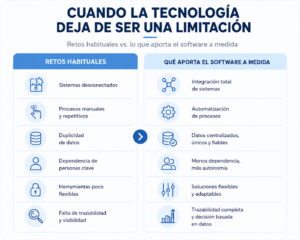
Most companies don’t need more tools. They need the ones they already have to work better together. And that’s where a good technology strategy makes all the difference.
Beyond development: integration, scalability, and evolution.
Building something that works today isn’t the hard part. The challenge is keeping it working when the business changes, grows, or evolves. A solution not designed for integration and evolution becomes a problem sooner than expected.
That’s why more and more organizations prioritize solutions capable of coexisting with:
- ERPs
- CRMs
- Cloud platforms
- Analytics tools
- Industrial environments
- Or AI-based systems.
And doing so securely, efficiently, and sustainably. Not as a technical objective, but as a necessary condition for the investment to make long-term sense.
Artificial Intelligence and automation: a new era of enterprise software.
AI delivers significant value. But only if the foundation it’s built upon is ready. In the following table, you can see where it’s having an impact: Document classification, internal assistants, operations automation, predictive analytics, advanced data exploitation, or improved customer service. You can click on the table to see it in more detail.
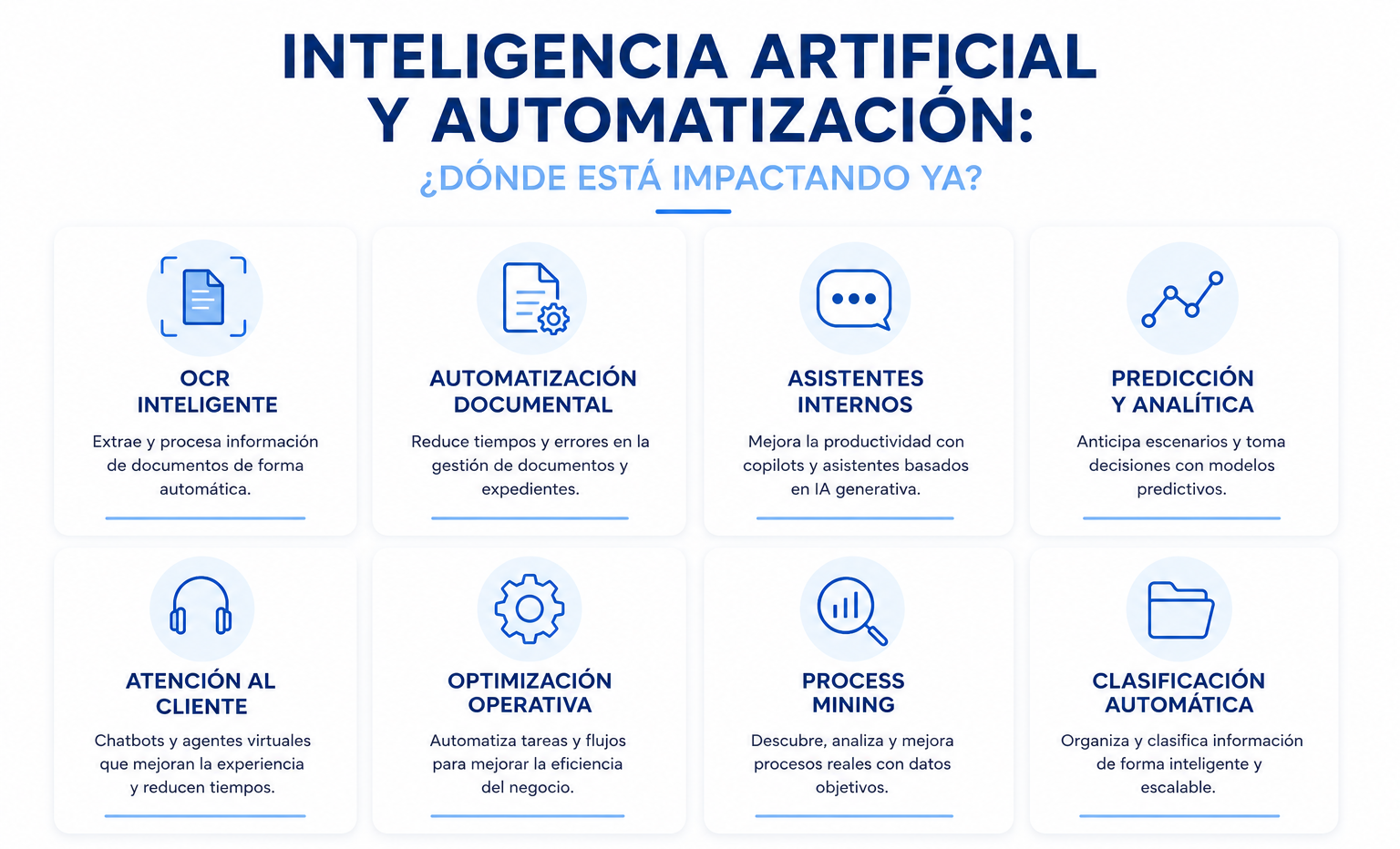
The use cases are enormous, but it’s worth stating clearly: AI doesn’t fix a messy process. If data is poorly structured or flows lack logic, applying artificial intelligence doesn’t improve anything. In some cases, it even amplifies the problem.
Before talking about AI, it’s worth asking if the systems that will feed it are truly ready. When they are, the possibilities change completely.
An increasingly business-oriented approach.
Companies are no longer just looking for technology providers. They are looking for partners capable of truly understanding the problem at hand.
And that requires combining technical capability with operational insight. Asking questions, understanding processes, challenging inertia, and building solutions that truly fit into the organization’s daily operations.
Our Chief Sales Officer (CSO), Beatriz Flores highlights that “a well-built solution isn’t the one with the most features. It’s the one people use without friction. The one that improves real processes. And the one that generates a tangible impact on the business.”
Technology designed to support growth.
There is no universal formula. Each company has a different reality, different processes, and different challenges. But one thing we constantly see is that the companies that advance the most are not those with the most technology. They are those with the right technology for who they are today and for what they want to be tomorrow.
Digital transformation is not just about digitizing processes. It’s about building a technological foundation capable of growing, adapting, and integrating sustainably with the business.
And often, the first step isn’t to incorporate more tools.
It’s about connecting the ones that already exist — properly.