

In the race for productivity, many companies’ instinctive response is often “we need more staff” or “we need better technology.” However, the reality we’ve observed at MindDen is often simpler than we think: the talent is there, but it’s poorly distributed. Artificial Intelligence has proven to be the perfect ally for understanding not only what is being done, but who does it best, transforming efficiency while respecting the human factor.
1. The myth of random versatility.
In high-performance sectors like Retail and Industry, it’s common to assign tasks based on shifts, availability, or hierarchy. It’s assumed that, with adequate training, any professional will perform equally well at any stage of the process. But the data tells a different story.
In a recent project with a Retail chain that used 3D scanning for its e-commerce, the team had the best technology, but publication times weren’t adding up. The company didn’t understand why, with the same tools, performance fluctuated so much.
2. AI for measuring affinity, not surveillance.
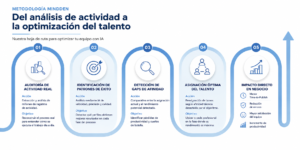
Through AI, we analyzed the complete process cycles. We weren’t looking to scrutinize employees, but to understand their true affinity with each phase of the task.
According to our AI Lead, the key was clean data analysis:
“We identified which profiles completed each phase with greater speed and a lower error rate. We discovered that excellence wasn’t uniform; some were brilliant at technical capture and others at image post-processing”.
3. Results without infrastructure investment.
The solution didn’t require hiring anyone new or purchasing additional software. The workflow was simply reorganized based on the success patterns detected by AI:
- Smart reassignment: Each person was placed in the position where their natural and technical talent flowed best.
- Error reduction: By working on what they did best, the error rate dropped dramatically.
- Optimized time-to-publish: The time for a product to go online was significantly reduced, directly impacting sales.
Our conclusion? Talent empowered by data.
Optimizing a company doesn’t always mean automating to replace humans; it often means using AI to help humans stop wasting time on tasks that don’t fit their profile. When you put each person where they contribute the most, productivity stops being an effort and becomes a natural consequence of the process.
Cómo la Inteligencia Artificial identifica y resuelve tus cuellos de botella