

The Internet of Things (IoT) has reshaped how we collect, transmit, and use data. Sensors, chips, and connected devices have become critical assets for companies and institutions seeking efficiency, control, and new business opportunities.
But behind every device lies a critical challenge: how to ensure efficient and secure communication.
IoT, Explained Clearly at Last: What It Is, Its Purpose, and Why You Already Use It Daily
The Role of Protocols in IoT
Sensors do not operate in isolation. To be valuable, they need to transmit the data they collect to networks, platforms, or applications. This is where communication protocols come into play, determining key aspects such as energy consumption, coverage, transmission speed, and security. Choosing the right protocol is, therefore, a decisive factor in the success of any IoT deployment.
IoT Protocols: Evolution and Differences
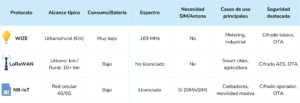
🔹 WIZE
A French-developed protocol, based on 169 MHz and derived from the European Wireless M-BUS, designed for metering (water, gas, electricity) and industrial applications. It is characterized by low power consumption, high signal penetration, and wide-area deployment capabilities. Source: Wize Alliance
Choose WIZE if:
- You need penetration in complex environments (underground, buildings with many walls).
- Your application is primarily metering or industrial.
- You are looking for a protocol with low power consumption and long battery life.
Real-world example:
A water company that wants to install smart meters in old buildings with basements and thick walls can use WIZE for each meter to reliably send consumption data, without the need for additional repeaters.
🔹 LoRaWAN
A widely adopted open standard that enables low-power communications over long distances (kilometers in cities and tens in rural environments). Its main applications are in agriculture, smart cities and logistics. It is flexible and has a broad ecosystem of gateways and modules. Source: LoRa Alliance
Choose LoRaWAN if:
- You are looking for an open protocol with a broad ecosystem and community support.
- You want to deploy sensors over long distances without relying on mobile operators.
- Your project requires bidirectional communication with low power consumption and deployment flexibility.
Real-world example:
A smart farm installs humidity and temperature sensors in extensive fields. Thanks to LoRaWAN, each sensor sends data several times a day to a central gateway without needing a mobile network, optimizing irrigation and fertilizer use.
🔹 NB-IoT (Narrowband-IoT)
A cellular technology defined by 3GPP, aimed at low-power devices that transmit small data packets. It operates on mobile networks (4G/5G) and is based on SIM/eSIM cards, eliminating the need to deploy dedicated infrastructure. It is particularly advantageous in massive deployments managed by operators. Source: GSA
Choose NB-IoT if:
- You want guaranteed coverage by mobile operators without deploying your own infrastructure.
- Your device sends small but frequent data (meters, mobile sensors).
- You are looking for a massive deployment with managed network support and integrated operator-level security.
Real-world example:
A city wants to install thousands of connected electricity meters throughout the urban area. Each meter sends data every hour using NB-IoT with existing 4G network coverage, avoiding the need to install new antennas or gateways and ensuring security and reliability.
These protocols are rely on strategic chips or devices that collect data and send it to the network. Each option impacts coverage, energy consumption, and infrastructure.
Security: The Biggest Challenge Ahead
The accelerated growth of IoT is not without risks. Many devices lack secure update mechanisms (OTA), exposing critical vulnerabilities.
Recommended Best Practices (OWASP / IETF / ENISA):
- End-to-end encryption and mutual authentication between device and server.
- Secure OTA updates: digitally signed firmware, protection against rollback.
- Centralized device management: inventory, credential revocation, and continuous monitoring.
It’s not just about protecting information: we’re talking about business continuity and critical infrastructure.
WIZE, LoRaWAN, and NB-IoT represent three paths to smart connectivity. Their suitability depends on factors such as coverage, cost, and mobility, but they all share one common point: security is the decisive element for IoT to become a driver of future innovation and not a source of vulnerability.