The essentials
The Internet has changed. So has our use of it.
There was a time when the Internet tied up the phone line, and every page demanded patience. Today, it has become almost invisible behind the apps, cloud services, and systems we use daily. What changes made this evolution possible—and why might AI integration mark the beginning of a new era?
If you recognize the sound of a modem connecting, you probably also remember that browsing the Internet required a certain family organization.
—Are you going to be long?
—I need to use the phone.
Today it seems a scene from another era, but it wasn’t that long ago. We would connect for a while, send emails, and when we finished, we would log off the Internet.
Now we do the exact opposite: we live connected, and every now and then, we try to disconnect.
On Internaut Day, we look back, not only to recall some scenes from our digital history, but to understand how a technology we used occasionally has become the foundation of almost everything we do.
The decision that allowed an open Web to be built.
The World Wide Web was born in 1989 at the European Organization for Nuclear Research (CERN) to facilitate the exchange of information among scientists from different universities and institutions.
By the end of 1990, the first server, the first browser and a page explaining how to use that system were already operational. But the real turning point came on April 30, 1993, when CERN made the Web software publicly available so it could be used, modified, and distributed.
That decision prevented the Web from being locked into proprietary technology and allowed people and organizations from anywhere in the world to build on a common foundation.
More than three decades later, these principles still hold true: shared standards, interoperability, and systems capable of connecting and evolving without requiring the replacement of everything that already works.
The first webpage can still be visited thanks to the recovery project by the CERN. Its appearance is extremely simple, but behind it was already the idea that would end up transforming almost everything: connecting information so it could be shared.
When speed shaped the experience.
Early home connections were not exactly known for their speed. Pages appeared in parts, images loaded line by line, and downloading a song could take up a good part of the afternoon. Those limitations also influenced development. Each image had a cost in loading time, interfaces had to be lightweight, and any interaction was conditioned by the available bandwidth.
As connections improved, pages began to turn into applications. Multimedia content, e-commerce, collaborative platforms, and new ways of creating communities arrived.
We also changed with them. We chose our first email addresses, participated in forums, wrote on blogs, and turned Messenger statuses into a way to communicate —or to drop a hint—.
The Internet was no longer just for looking up information. It had also become a space to connect, express ourselves, and build a digital identity.
The Internet stopped being a destination.
Broadband eliminated much of the waiting, but the most profound change came when the Internet left the computer.
The smartphone made the connection permanent. This evolution was accelerated by the cloud, APIs, and the proliferation of connected services. Many of the actions we perform from an application today depend on several systems exchanging information in the background, even if for the user everything happens with a single gesture.
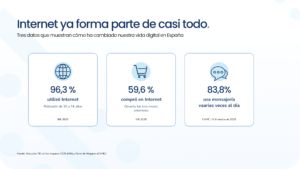
The Internet became so commonplace that it practically disappeared from view. In 2025, 96.3% of the Spanish population aged 16 to 74 had used the Internet in the previous three months and almost six out of ten people had bought online, according to the INE’s survey on the use of technologies in households.
We no longer say “I’m going to connect.” We simply open an application and do what we need to.
AI leaves the chat and enters processes.
Generative artificial intelligence has normalized a new way of interacting with technology: we no longer just press buttons or enter terms into a search engine; we also explain what we need using natural language.
Adoption has been rapid. In 2025, 37.9% of the Spanish population aged 16 to 74 had used some generative AI tool. Among young people aged 16 to 24, the percentage reached 75.6%, according to the INE. But the real change for organizations is not just having a chat capable of answering questions. It begins when AI can access, with the appropriate permissions, the information and applications that are already part of daily work.
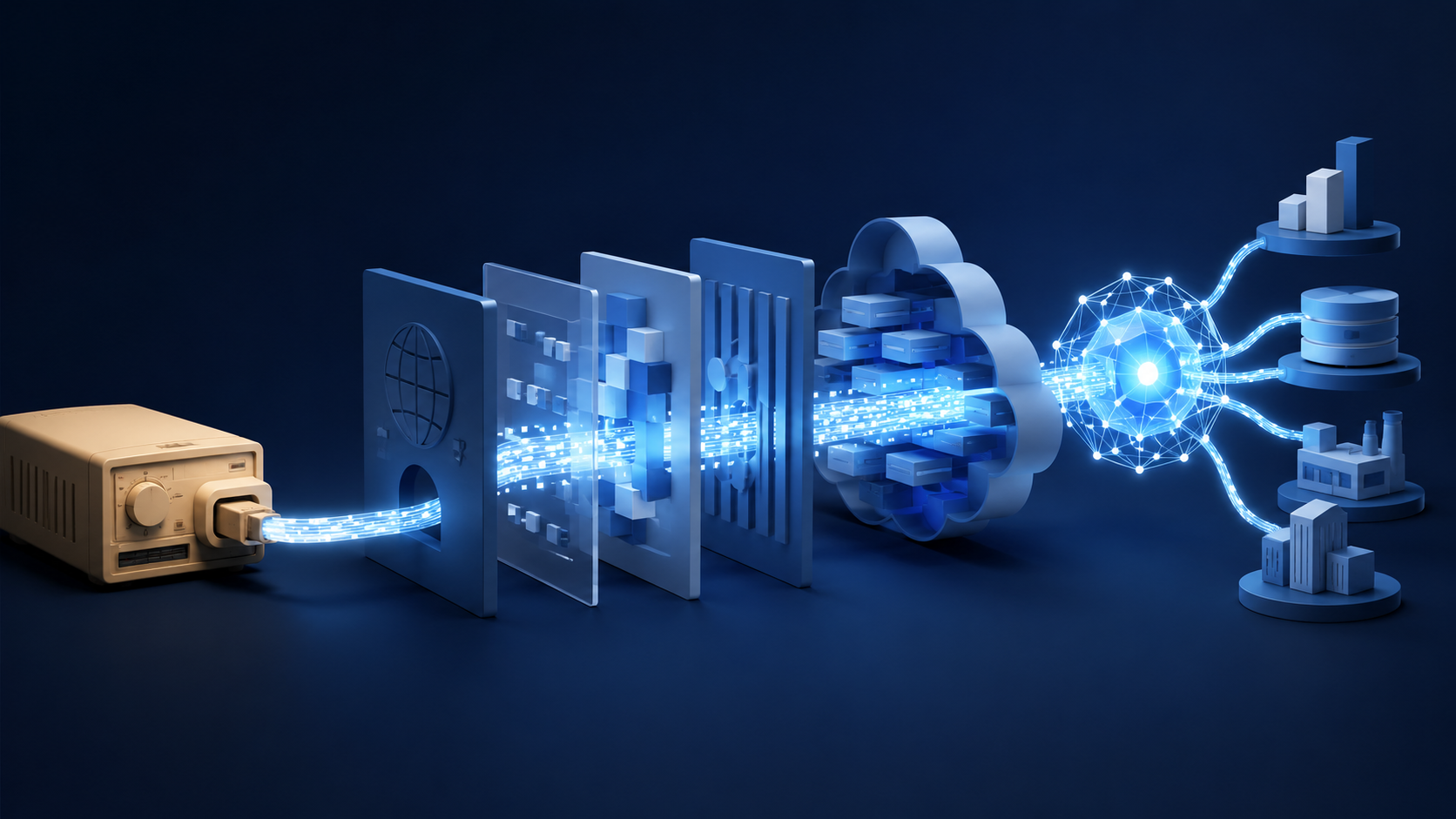
An agent connected to an ERP, CRM, or document management system can locate information, prepare a report, classify documentation, log an incident, or trigger a task. AI is no longer an isolated tool and becomes integrated into a process.
Getting there requires more than just choosing a model. Before automating, it’s necessary to understand how the process truly works, where bottlenecks occur, and which actions make sense to delegate. Afterward, access, rules, traceability, and the moments when a person must intervene need to be defined.
Stanford’s AI Index 2026 shows that 88% of organizations included in its surveys already used AI in some business function. However, the implementation of agents capable of executing actions was still at an early stage. This is where one of the next major technological changes lies: moving from conversing with AI to securely and usefully incorporating it into the systems and processes that already support an organization, without needing to start from scratch.
Before, it was hard to connect. Now, it’s hard to disconnect.
The modem ended the connection when we turned off the computer. Today, we carry the Internet in our pockets, on our watches, in our cars, and in many of the services we use daily.
This evolution allows us to work, learn, communicate, and create with an ease that thirty years ago would have seemed like science fiction. It also forces us to decide what we share, what information we believe, what data we give to an application, and when we need to put the screen aside.
At MindDen, we have been experiencing this transformation from within for ten years: developing software, connecting systems, and accompanying the emergence of new ways of working with technology. Now we are also participating in the transition from AI used as an independent tool to AI integrated into real processes and applications.
The Internet has changed a lot.
And we, as Internet users, have too.