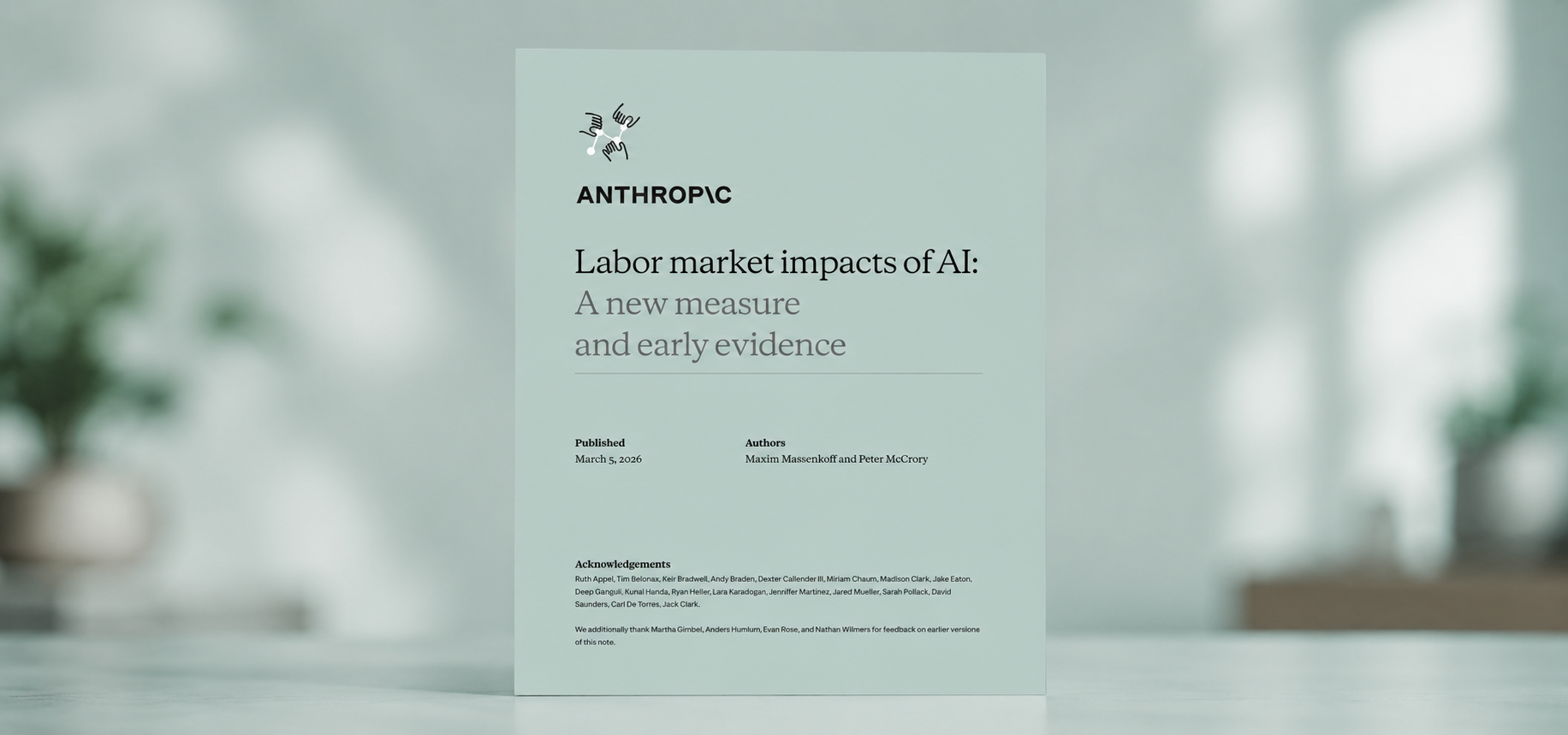
A few months ago, Anthropic published a report on AI’s potential impact on the labor market: Labor market impacts of AI: A new measure and early evidence. Among its conclusions, one particularly striking piece of data stood out: in certain technological profiles, artificial intelligence tools are already capable of covering a very significant portion of daily tasks. As a result, the report predicts that around 75% of the workforce in our sector could be displaced by AI in the coming years.
That figure has been swirling in my head ever since. Has AI come to take our jobs? Have computer scientists created their own meteor? And since no one knows AI better than AI itself, I decided to ask three of the most well-known AI tools—ChatGPT, Claude, and Gemini—for their perspective. The prompt is simple:
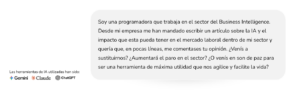
They all agree on the same idea: “We are not here to replace, we are here to transform”. And I fully agree with the idea they put forward. As Gemini comments, “the productivity of a BI developer empowered with AI tools can be 40–50% higher.”
Professionals in the sector are already witnessing how AI is changing the way we work. Many of the most repetitive and mechanical tasks are gradually disappearing from our routine. Code generation, documentation, generating simple queries, or creating basic dashboards are processes that used to consume many hours of our workday and can now be resolved in minutes thanks to automation and the effective use of these tools.
“However, in BI, the true value is not just in producing data, but in interpreting it, contextualizing it, and converting it into business decisions. There, human experience remains key. AI can detect patterns, generate code, or accelerate analysis, but it still requires supervision, judgment, and business knowledge. In that sense, rather than replacing analysts or developers, it will probably redefine their functions. AI is not necessarily arriving “on a war footing”, but it does force the sector to evolve,” comments ChatGPT.
And it is true that this is not the first IT revolution the world has faced. As Claude rightly suggests, “the historical experience with other disruptive technologies (ERPs, cloud, big data) shows that the sector reinvents itself more than it destroys, and ends up generating new profiles that did not exist before.”

Will we know how to reinvent ourselves again?
I don’t have a crystal ball to know what will happen, but what I do believe is that AI will not replace professionals who bring judgment, vision, and adaptability. Those who understand their context and can leverage these tools effectively will face a lower risk of being replaced than those who do not evolve alongside them. The question is probably no longer whether artificial intelligence will change our work, but whether we can evolve at the same pace.
But above all, have we all seen Terminator?