
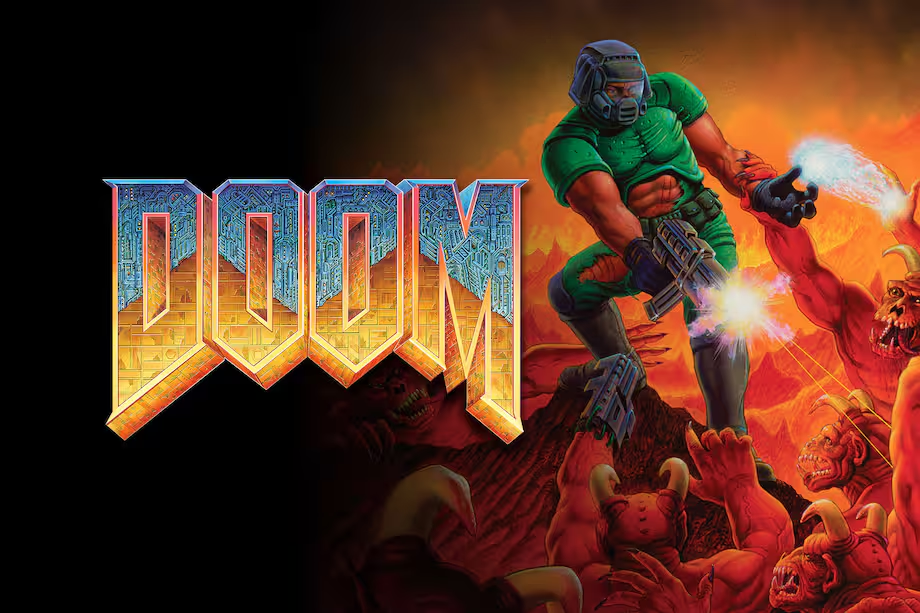
In late 1993, IT departments worldwide, from Intel to the most prestigious universities, began to detect a problem. Their local area networks (LANs) were crashing for no apparent reason. It wasn’t a virus or a cyberattack, but a file of just a few megabytes that spread from computer to computer via floppy disks. Its name was DOOM, and it had just invented “Deathmatch.”
In our Open Source section, today we journey to the roots of modern programming to understand how a video game forever changed the rules of software development.
The Mathematical Illusion: A Graphics Engine Ahead of Its Time.
Today, rendering three-dimensional environments is the standard, but in the early 90s, home processors lacked the computational power to render true 3D worlds. John Carmack, the legendary programmer behind the game, solved this technical limitation with pure mathematical genius.
Carmack used a technique known as Raycasting combined with Binary Space Partitioning (BSP Trees). In practice, the DOOM engine wasn’t truly 3D, but an incredibly clever two-dimensional environment that tricked the human eye by simulating height and depth. It was a great lesson in resource optimization.
When you analyze the original DOOM code, you realize it’s a piece of pure craftsmanship. Carmack performed technical magic. It’s the perfect example that sometimes the best solution isn’t brute force, but the ability to think outside the box to optimize resources to their limit.
The “Deathmatch Effect” and Office Chaos.
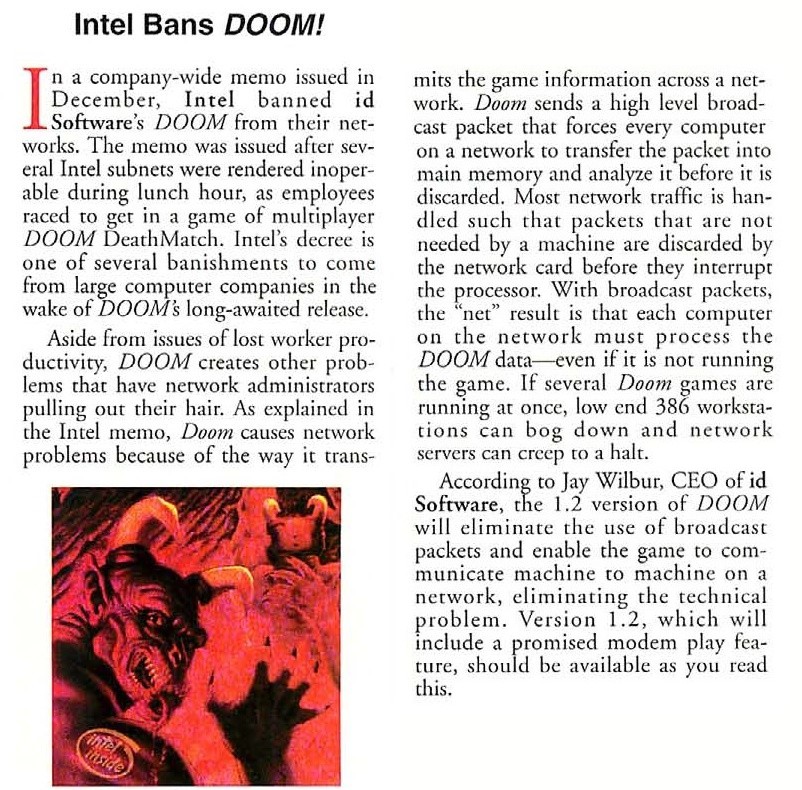
The game was not only a graphical marvel; it was the first title to massively popularize local network multiplayer mode. Employees discovered they could connect their office computers to hunt down their colleagues in the game’s virtual hallways.
Network packet traffic was so intense that companies and institutions were forced to draft strict policies that explicitly prohibited playing DOOM during work hours to prevent their servers from crashing.
Imagine being a system administrator in ’94 and watching your entire company network crash because the accounting department was playing a Deathmatch. Today, we configure cloud clusters to handle millions of requests, but that was the first real stress test for many network infrastructures.
“Will it run DOOM?”: The Meme That Honors Open Source.
In 1997, id Software made an industry-changing decision: John Carmack released the source code of the original graphics engine under an open-source license.
This allowed thousands of novice developers to dissect the game, understand how it worked internally, and create their own versions. It was the seed of what we now know as the modding community and a vital boost for the Open Source philosophy: https://github.com/id-Software/DOOM
Carmack himself summarized this mindset with a quote that has gone down in history:
“Programming is not a zero-sum game. Teaching something to a fellow programmer doesn’t take anything away from you. I’m happy that people can learn from my code.” — John Carmack, co-founder of id Software.
The C-language engine’s lightweight nature and its open-source code gave birth to software engineering’s greatest meme: the challenge of running DOOM on any device with a microprocessor. To this day, the community has managed to run it on a refrigerator’s touchscreen, a tractor, a bus’s ticketing machine, an electronic pregnancy test, and, incredibly, using intestinal bacteria (E. coli) as biological pixels, as in the “MIT researcher runs Doom using E. coli cells” experiment conducted by MIT in 2024.
The Enduring Lesson.
More than 30 years later, DOOM remains a benchmark. It reminds us that hardware limitations foster creativity, that open source is the greatest accelerator of innovation, and that the technical community has a great sense of humor.
At MindDen, we share that same curiosity. Because, at the end of the day, developing software is about solving complex problems, learning from those who came before, and, every now and then, asking: “Okay, but can it run DOOM?”.